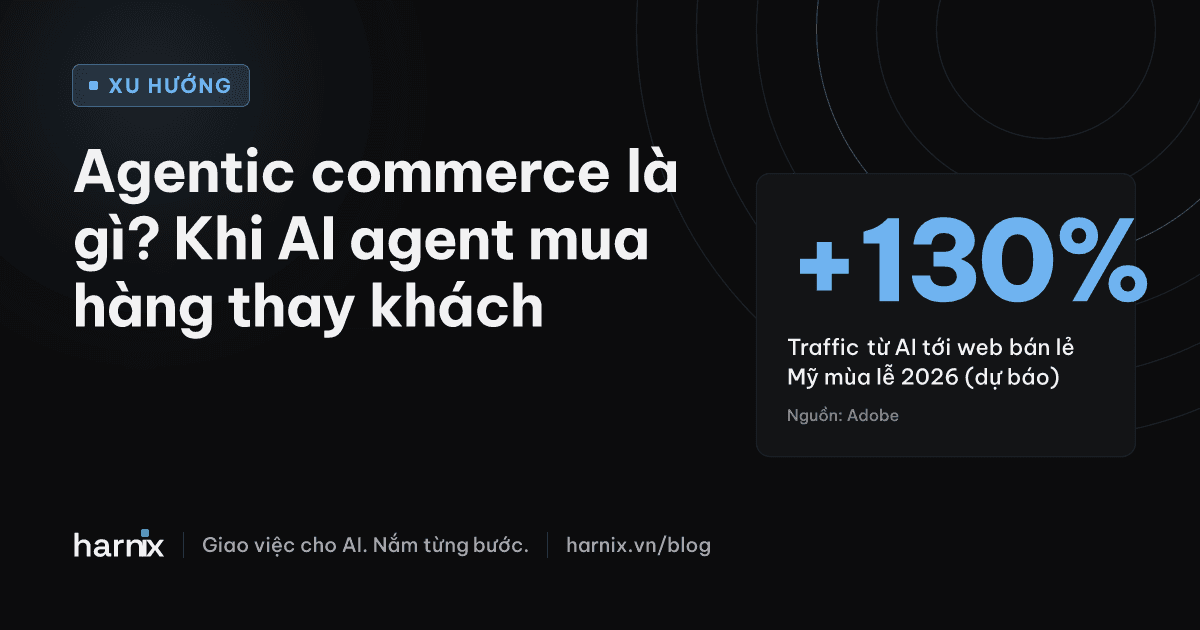
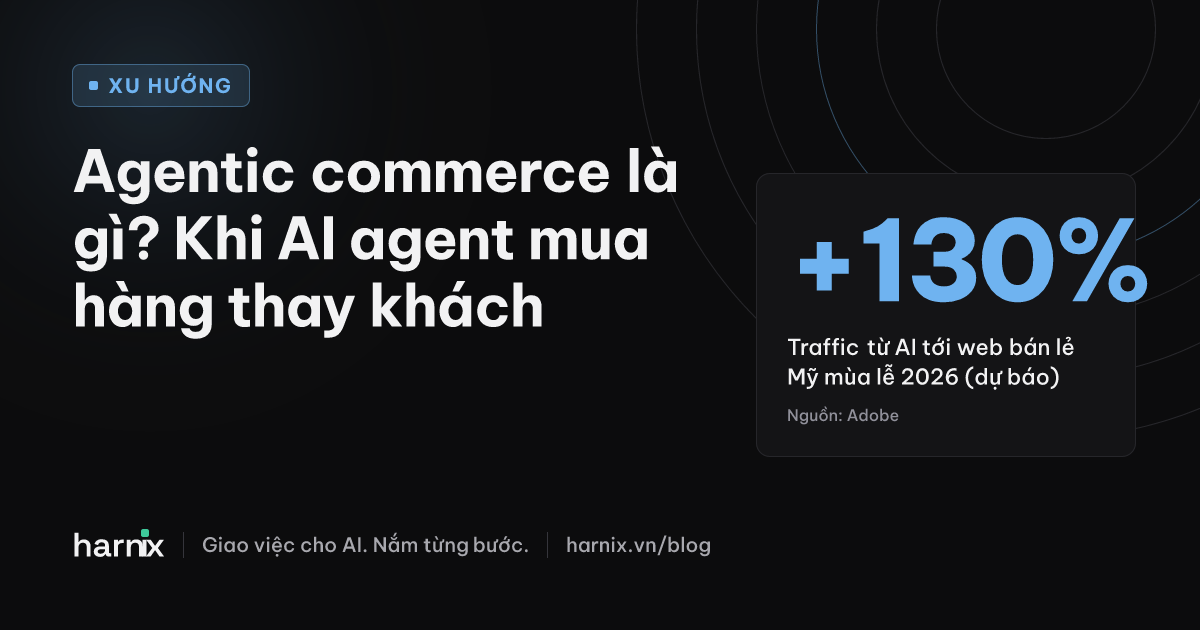
Agentic commerce is shopping where an AI agent finds products, compares prices, and places orders on the buyer's behalf, while the buyer sets the goal and approves. In October 2026, Walmart and Google put this model into real products, and Adobe forecasts that AI-driven traffic to US retail sites will grow 130% this holiday season. For small and mid-sized businesses, the practical question is what your store needs in place so agents can work with it safely.
What is agentic commerce?
In familiar e-commerce, the buyer opens the site, filters, adds to cart, and pays. In agentic commerce, the buyer hands the job to an AI agent, for example "reorder the diapers we usually buy, under $20, delivered by Friday." The agent checks stock, compares prices, then places the order or sends it back for the buyer to confirm.
The difference is that the agent does more than answer questions. It calls the store's tools (check inventory, build a cart, place an order) and acts for the person. So the most important question for a store becomes which actions it opens to agents, and with what limits.
What happened in the market last month?
Each of these has a specific date and press coverage:
| Date | Event | Why it matters |
|---|---|---|
| Oct 15, 2026 | Google rolls out Universal Cart in the US across Google Search and the Gemini app (9to5Google) | One cart across many retailers, price-drop tracking, checkout via the Universal Commerce Protocol at participating merchants |
| Oct 21, 2026 | Walmart announces Agent Gateway, an MCP server for approved agents (TechCrunch) | Agents search and buy for customers without directly receiving their personal information or purchase history |
| Sep 28, 2026 | Adobe publishes its holiday forecast (Adobe) | AI traffic to US retail sites for Nov 1–Dec 31, 2026 up 130% year over year; total online spend expected at $275.1 billion |
Two things stand out. First, Walmart chose the Model Context Protocol (MCP), an open standard for connecting agents to outside tools and data, as the doorway for agents. Second, Adobe's number counts shoppers clicking links from AI services to retail sites, so it still describes "AI recommends, the person buys" more than agents checking out on their own.
Three principles becoming the common standard
Walmart's terms for agents (TechCrunch, Customer Experience Dive) point to three principles any store that lets agents act should adopt.
1. The buyer keeps the final say
Customers can require the agent to ask for approval on every transaction, or let it buy within a spending limit they set. Walmart compares this to adding an authorized user to a credit card. Agents may not act beyond the shopper's intent.
2. The agent sees only what the task needs
Under Walmart's terms, agents cannot access payment information and may only access data needed for the task. It is the familiar least-privilege rule from security, now applied to customers that are machines.
3. Everything the agent does is separated and traceable
Walmart's Agent Profiles give each agent its own profile inside the customer's account, so agent orders appear separately from the customer's own, and the customer can delete a profile at any time. Agents that don't comply with the terms will be blocked.
We covered approvals and limits for agents in more depth in AI agent permissions: approvals, limits, and a stop button.
How should small businesses prepare?
All of the news above is from the US market. We have not seen reliable public data on how many shoppers in Vietnam let agents place orders for them. There is no need to rush, but five early steps pay off even if your customers only ever use the chatbot inside your own app:
- Clean up product data. Names, prices, stock, and return policies should be consistent and machine-readable. Any agent, yours or someone else's, is only as accurate as that data.
- Separate read actions from write actions. Checking a price or an order is a read. Placing, cancelling, or changing an order is a write. Writes should require the user's confirmation.
- Set limits from day one. Caps on requests, spend, and actions per user block abuse and keep costs predictable.
- Record every step the agent takes. When a customer asks "why was this order placed?", you need to see what the agent read, which tool it called, and who confirmed.
- Expose tools through a shared standard. If you later want outside agents to connect, an MCP server in front of your existing API is the route several large platforms are taking. Start with read-only tools.
A sensible path for a small business is to start with your own agent in your app or website: product advice grounded in your documents, order lookups, and only then ordering with confirmation. Once those run smoothly with clear logs, opening up to outside agents carries far less risk.
Agentic commerce vs. a sales chatbot
| Sales chatbot | Agent in agentic commerce | |
|---|---|---|
| Main job | Answer questions, suggest products | Do the work: check stock, build a cart, place the order |
| Who takes the final action | The buyer orders | The agent orders; the buyer approves or sets a limit |
| Main risk | Wrong information | Wrong action: wrong item, over budget |
| What you need | Accurate documents, cited sources | Plus confirmations, limits, step-by-step logs |
Where Harnix fits
With Harnix, you connect your store's tools (an MCP server or connector) to an agent, choose which tools each agent may use, and turn on the confirmation setting so the agent asks the user before any write action such as placing an order; every Run is recorded step by step so you can trace it later. See how in the Harnix docs, or get in touch at harnix.vn.
Frequently asked questions
How is agentic commerce different from regular e-commerce?
In regular e-commerce, the buyer performs every step. In agentic commerce, an AI agent performs them (search, compare, order) while the buyer sets the goal and limits and approves.
What does MCP have to do with agentic commerce?
The Model Context Protocol is an open standard for connecting agents to outside tools and data. Walmart uses an MCP server as the gateway that lets approved agents search and buy for customers.
Does a small store need to act now?
Not to open up to outside agents. But it is worth cleaning product data, separating reads from writes, and adding confirmations and logs to the chatbot or agent in your own app.
Is it safe to let an agent place orders?
It is safer with three layers: the buyer approves each transaction or sets a limit, the agent sees only the data it needs, and every action is logged for tracing.