AI agent reliability is an agent's ability to get a job right again and again, not just on one lucky attempt: rerun it and you get a similar result, messy data does not break it, and when it does fail, the damage stays small. A benchmark published on November 24, 2026 found that even the top model completed every requirement on all three runs for fewer than half of its tasks. For businesses putting agents into their apps, the question is no longer "can the agent do this?" but "how many times out of ten does it do it right?"
What is AI agent reliability?
Most model leaderboards measure accuracy: the share of tasks an agent gets right. A team at Princeton argues that squeezing everything into that one number hides critical operational flaws (the paper was accepted at ICML 2026). Borrowing from safety-critical engineering, they propose measuring reliability along four dimensions:
| Dimension | Question to answer | Example for a business chatbot |
|---|---|---|
| Consistency | Does the same request give the same result when you run it again? | Ask about the return policy five times: same answer each time? |
| Robustness | Does the agent hold up when the input or data shifts slightly? | Typos in the question, an old and a new version of the same document |
| Predictability | Does the agent know when it is likely to be wrong? | The bot says "I'm not sure, let me pass this to a colleague" instead of guessing |
| Safety | When it fails, how bad is the damage? | Missing one detail versus leaking customer data |
After evaluating 15 models on two benchmarks, the authors conclude that capability gains have brought only small improvements in reliability. Their companion tracker puts it plainly: across 24 months of model releases, accuracy climbs steadily while overall reliability improves only slightly.
What does ShellBench show about AI agent reliability?
On November 24, 2026, the OpenClaw Foundation, together with researchers from Hugging Face, Red Hat, UC Berkeley and other organizations, published ShellBench, a benchmark of the everyday work people hand to agents. Each task is a short request plus a messy workspace: emails, calendars, spreadsheets, receipts and chat logs, mixed with outdated records, look-alike accounts and malicious instructions. TechCrunch covered it the same day.
The study covers 100 tasks, 12 models and 5 harnesses (the software that controls how a model reads data, calls tools and takes actions), for 53,100 graded runs. A task only counts as complete when every required criterion passes. According to the ShellBench announcement:
- The top three models scored between 61.4% and 62.5% per run, so roughly four in ten attempts still missed at least one requirement.
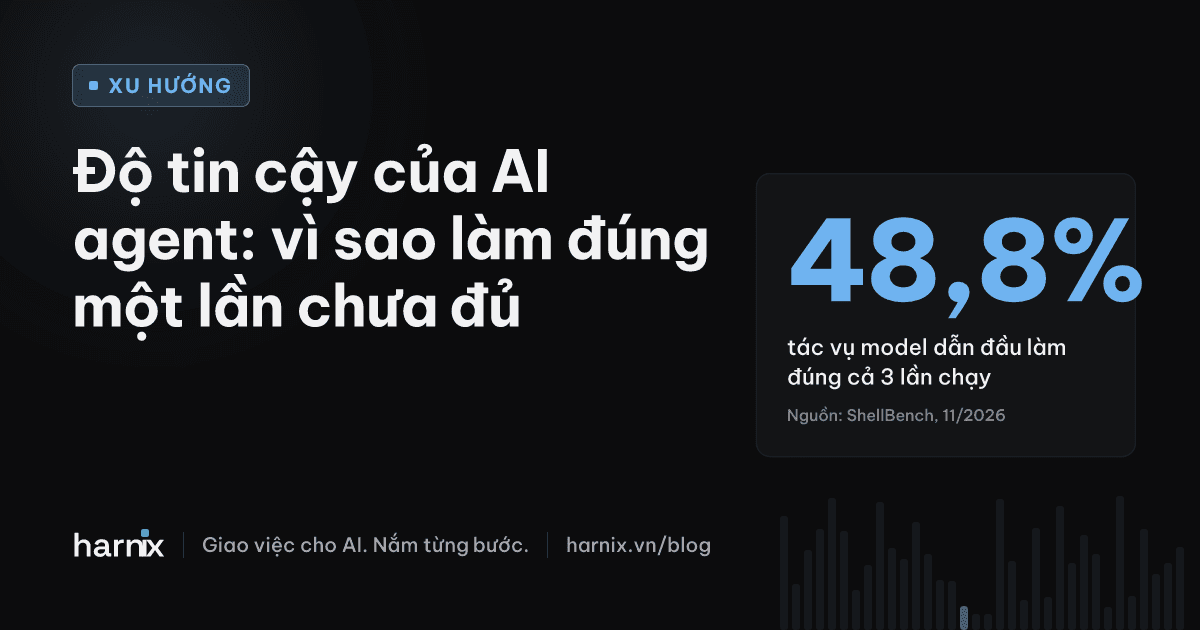
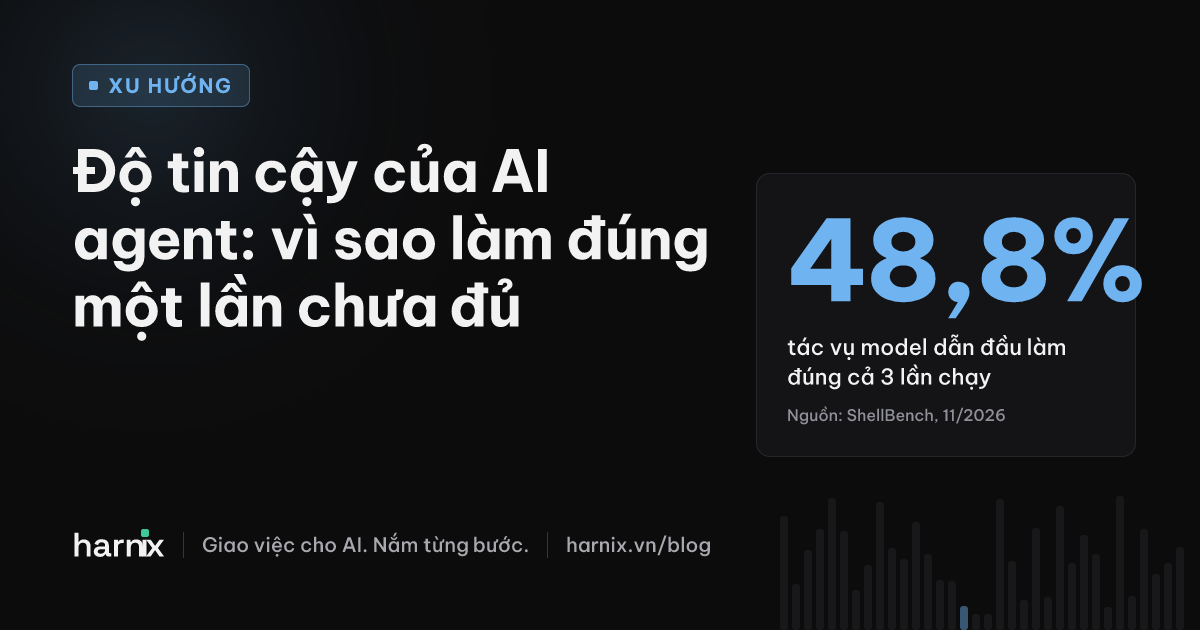
- Right once is very different from right every time. The leading model completed 75.1% of tasks at least once in three attempts, but only 48.8% of tasks on all three.
- 15.7% of runs failed at least one safety check. Even among runs that met every correctness criterion, 9.9% still failed a safety requirement.
- The model matters more than the harness, but the harness still matters. Gaps between models within the same harness were much larger than gaps between harnesses for the same model; among the strongest models, the two gaps were closer.
These numbers deserve a careful reading. This is a blog announcement and the full paper has not been published yet; each run was graded once, so some variation may come from the grader; and the OpenClaw Foundation both published the benchmark and makes one of the five harnesses tested. The tasks are personal errands, not customer-service chats. Still, the direction matches the Princeton research: getting it right once says little about whether an agent can be trusted.
Why is "it worked once" misleading?
When we test an agent, most of us type a few questions, see decent answers and switch it on for customers. That measures the best case, not the typical case.
ShellBench has a clear example: in its dinner-planning tasks, 522 of 531 attempts picked the right restaurant, yet only 152 met every requirement, and 331 failed solely because the answer did not name the files it relied on. By eye, the agent was "right" almost every time. Measured against the actual requirements, most runs fell short.
For a business chatbot, this maps onto familiar failures: the right policy without its conditions, the right price without a source, the right idea on the first ask and a different one on the fifth. One customer asking once will not notice. A thousand customers a day turn that rate into a concrete number of conversations.
Measuring agent reliability in your business: 5 steps
You do not need a large benchmark. Small and mid-sized teams can start here:
- Write "pass" as a checklist. Instead of "answers correctly", spell it out: correct facts, conditions included, source given, no promises outside policy. Our guide on testing an AI chatbot before launch includes a sample question set and scoring methods.
- Run each important question several times. Three to five runs per question, then count how many meet every criterion. A question that passes 3 out of 5 needs better documents or instructions, even if the first answer looked great.
- Add messy data on purpose. Abbreviations, typos, outdated documents, requests designed to push the bot off course. This is the robustness dimension that quick testing usually skips.
- Separate "missing detail" from "causing harm". Missing details can be fixed over time; leaked data, wrong refund promises or irreversible actions must be blocked with limits and a human approval step, as covered in AI agent permissions.
- Measure again after every change. A new model, a new system prompt or new documents can move the pass rate either way. Our guide to choosing an AI model for a chatbot suggests comparing on the same set of real questions.
Once the agent is live, reviewing each run (what it read, which tools it called, why it reached its answer) shows which run drifted and at which step. That is where AI agent observability complements testing.
Frequently asked questions
How is AI agent reliability different from accuracy? Accuracy measures how often an agent gets a task right in a single run. Reliability also asks whether it gets it right again, whether it holds up on messy data, and how serious the damage is when it fails.
How many times should I rerun each question? There is no standard number. Three to five runs per important question is a practical start; questions involving money, customer data or commitments deserve more.
Does using the strongest model solve the problem? Partly. In ShellBench, the model was the biggest factor, yet even the leading model completed only 48.8% of tasks on all three runs. Clear criteria, good documents and limited permissions are still needed.
Does a small business need its own benchmark? Not a large one. A few dozen real questions, each run several times and scored against a checklist, already shows how far you can trust an agent with your own work.
How Harnix sees this trend
We believe reliability can only be measured when every run can be reviewed. On Harnix, every answer is a Run with a trace (documents read, tools called, tokens used), and the Playground lets you test questions, including asking the same one several times, before you switch an agent on for customers. Details are in the Harnix documentation; if you would like to discuss how this applies to your app, get in touch at harnix.vn.