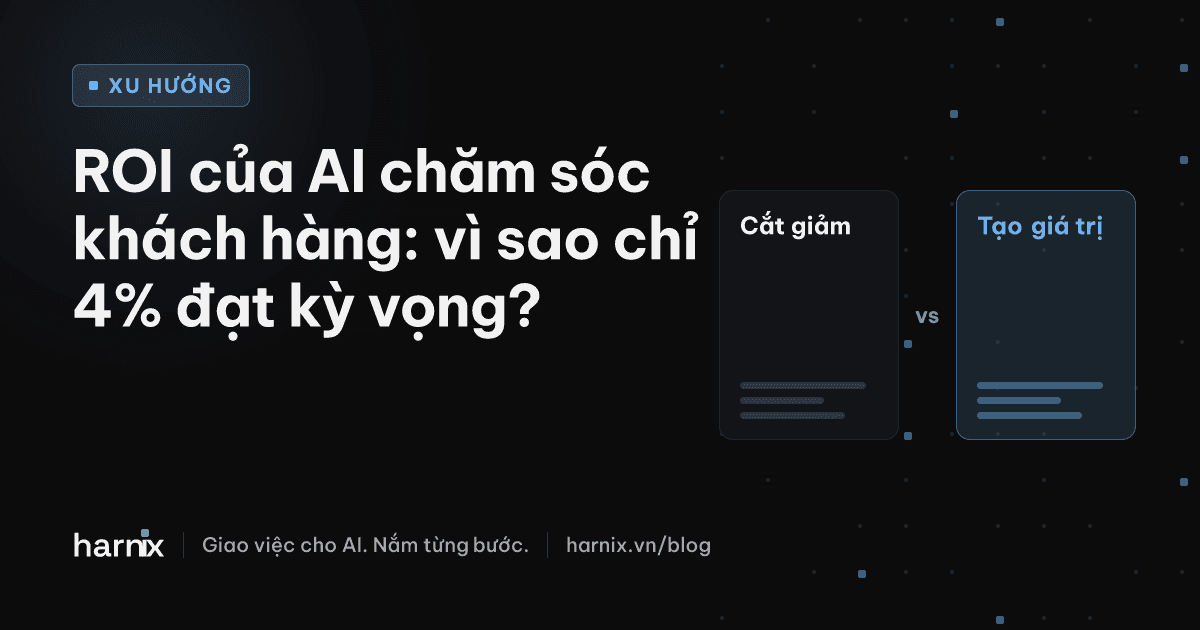

AI customer service ROI is the measurable value (revenue kept, costs reduced, happier customers) you get back from what you spend on chatbots and AI agents. In a Gartner survey of 275 customer service leaders released on November 4, 2026, only 4% said they had achieved the ROI they expected from their AI initiatives. The gap usually comes from how goals are set and measured rather than from the model: many companies only count headcount saved, while customers judge a chatbot by whether it actually solves their problem.
AI customer service ROI: the numbers in November 2026
The first weeks of November 2026 brought several new surveys on AI in customer service. Side by side, they show AI spending growing faster than the value companies can measure.
| Source | Key finding |
|---|---|
| Gartner, 275 customer service leaders, released Nov 4, 2026 (CX Dive) | Only 4% have achieved the expected ROI from their AI initiatives |
| Gartner, 275 service and support leaders, Nov 2026 (IT-Online) | 21% have cut human agent headcount because of AI (an average of 16.7% of staff over 18 months); 7% have already rehired, and 11% plan to rehire within 18 months |
| Gartner, Aug 2026 (destinationCRM) | AI spending by customer service leaders rose 38%, while overall service and support budgets grew just 2% |
| NiCE and Metrigy, 1,000 US consumers, released Nov 10, 2026 (CFOtech) | 54.7% choose a service channel mainly for accuracy; preference for an AI agent rose from 23% to 28.8% when people were told their issue would be resolved |
These surveys cover companies and consumers in the US and other large markets. The question they raise applies just as well to a small online store or a mid-sized software company anywhere: the chatbot has been live for a few months, so what has it delivered?
Why AI customer service struggles to deliver ROI
1. The only goal is cutting staff
CX Dive's analysis notes that many executives expect AI to be cheaper than people on each interaction. Then the only metric becomes headcount reduced. The rehiring numbers above show the risk: cut fast, rehire later, and lose the experience of the people who left. Gartner's Kathy Ross advises treating workforce reductions as an outcome of proven and sustained AI performance, not of expected value.
2. Efficiency gains never turn into money
AI helps agents resolve issues faster and write fewer after-call notes. As CX Dive points out, those gains don't automatically become revenue or market share. Unless they are tied to a specific business metric, they stay as nice numbers in an operations report.
3. Weak knowledge and data foundations
A chatbot answers from the documents and data you give it. An outdated return policy, an old price list, or two documents that contradict each other become wrong answers for customers. According to Christopher Sladdin, senior director analyst at Gartner, AI-forward organizations invest nearly 1.8 times more in these foundations than in the AI use cases themselves.
4. Customers lose trust when issues go unresolved
The NiCE and Metrigy survey found that 41% of consumers named trust as the most important factor, ahead of issue resolution at 35.4%. Patience is also shrinking: on average, people tolerate 2.78 bad experiences before leaving a company, down from 3.24 in Q1 2026. A chatbot that answers fast but wrong loses customers sooner than a long queue.
What customers want from a customer service chatbot
In the same NiCE and Metrigy research, the most popular model (39.4%) was AI and human agents switching automatically based on how complex the issue is. 37% preferred human-led service supported by AI, and 23.6% preferred AI-led service with people available when needed.
Customers aren't asking for "all AI" or "all human". They want the issue solved correctly, and a path to a person when the chatbot can't help. Sladdin puts it simply: humans and AI are not fit for the same job, and each delivers value in different ways.
5 steps to measure chatbot ROI for small and mid-sized businesses
1. Pick one primary goal before you measure
Cutting costs, retaining revenue, raising satisfaction, and extending support hours are four different goals that need different metrics. Gartner recommends pursuing fewer AI use cases and tying each one directly to a strategic objective. For a small business, one goal for the first three months is enough.
2. Measure per conversation, not just per month
Total message counts and the monthly bill can't tell you where the chatbot does well. For each conversation you want to know what the customer asked, which documents the bot read, what it answered, how many tokens it used, and whether the customer came back or switched channels. We covered the cost side in detail in AI token costs are rising: how businesses keep the bill in check.
3. Read conversations to learn, not only to score
Sladdin calls learning from customer interactions at scale AI's "superpower". Every week, pull out the questions the bot couldn't answer or that customers rated not helpful, group them by topic, and fix the documents. We walk through the process in Chatbot giving wrong answers: how to find and fix weak spots.
4. Clean up your documents before you scale
Before you turn the chatbot on for more products or channels, review policies, price lists, and FAQs. Remove old versions and reconcile answers that contradict each other. Few people enjoy this work, but it decides the quality of every answer.
5. Design the path to a person from day one
Decide which matters the chatbot should not settle on its own (refunds, complaints, warranty claims), and what the customer sees at that point: a hotline, a chat link, a contact form. Customers only come back to a chatbot when they trust they can reach a person when it matters.
Suggested metrics for measuring AI customer service ROI
| Metric | How to measure | Why it matters |
|---|---|---|
| First-contact resolution | Conversations that end without the customer asking again or switching channels | Customers judge a chatbot by whether their issue is solved |
| Customer helpfulness rating | Helpful/not helpful buttons under each answer | A direct signal, earlier than a satisfaction survey |
| Cost per conversation | Tokens and model fees for each conversation | Shows whether AI is actually cheaper, and for which questions |
| Unanswered questions | Questions where the bot found no information, grouped by topic | Points to the documents you need to add |
| Handoff rate | Conversations where the customer needed a person | Measures the work that should stay with people |
Measure these before and after every change (updating documents, switching models, editing prompts) so you know which changes create value.
How Harnix helps
In Harnix, every chatbot answer is a Run recorded step by step: the documents it read, the tools it called, and the token cost, along with the helpful/not helpful rating customers leave right under the answer. See how to set it up in the Harnix docs, or contact us at harnix.vn.
Frequently asked questions
How do you calculate customer service chatbot ROI?
Take the measurable value (lower support costs, revenue retained, extra customers served outside business hours), subtract the total cost of the chatbot (model fees, platform fees, time spent writing and updating documents), and divide by that total cost. The hard part is measuring value, so settle on one primary goal first.
Why do so many companies miss their expected AI ROI?
Common reasons: the only goal is cutting staff, efficiency gains aren't tied to business metrics, the underlying documents are outdated or contradictory, and customers stop trusting the chatbot when their issues go unresolved.
Should we replace customer service staff with AI?
Gartner advises cutting staff only after AI has shown sustained performance at an acceptable cost. Consumer surveys also show customers prefer AI and people working together over AI alone.
Which metric should a small business start with?
Start with first-contact resolution and cost per conversation. Together they tell you whether the chatbot gets the job done and whether it costs less than the old way.