AI token costs are what a business pays each time a language model reads and writes text, and they have become the hardest line in an AI budget to predict. In a survey of 1,500 IT leaders that Cloudera released in late October 2026, 89% said they had already limited or redesigned AI use cases because of rising token consumption. You don't have to cut AI to keep the bill in check. Start with three things: measure cost per run, match the model to the difficulty of the task, and set budgets per agent and per user.
What are AI token costs?
A token is the unit of text a language model uses to read, write and bill. Every customer question, every document passage placed into the context and every answer the model writes is counted in tokens. Model providers usually price input tokens and output tokens separately.
For a simple Q&A chatbot, the cost of each turn is fairly easy to estimate. AI agents are different. One user request can trigger several model calls: looking up documents, calling tools, reading the results and rewriting the answer. The same question might take three steps today and eight tomorrow, and the bill moves with it.
What businesses are running into: recent survey data
Several 2026 reports point the same way: token spending is growing faster than companies' ability to measure and forecast it.
| Source | Key finding |
|---|---|
| Cloudera, survey of 1,500 IT leaders, released October 2026 (iTWire) | 89% have limited or redesigned AI use cases because of rising token use; 45% have moved AI workloads because of higher or more volatile costs |
| Cloudera, same report (ITPro) | 90% say they can measure end-to-end AI costs at least somewhat accurately, but only 27% can do so "very accurately" |
| Accenture, survey of 750 executives, July 2026 (CIO Dive) | Only about one dollar in five of token spend shows up as a quantified financial outcome; 53% of token usage can be traced to a team or an individual user |
| EY US AI Pulse, 534 senior leaders, 2026 (TechInformed) | More than 80% of leaders at AI-investing organizations are concerned about token use and related costs |
| Gartner, August 2026 (CIO Dive) | AI inference costs are projected to grow more than fivefold through 2028 |
These surveys mostly cover large companies in the US, UK, Australia and a few other markets. The underlying problem looks the same at any size, though: the more people use your chatbot and the more tools your agents call, the harder the bill is to predict unless you measure from day one.
Why the AI bill grows even when each question seems cheap
Gartner puts it briefly: each new generation of AI capability needs more tokens, and often more expensive ones. In day-to-day operation, four causes come up most often:
- Agents take many steps. One request can involve several model calls: planning, retrieving documents, calling tools, checking results. Every step costs tokens.
- Context keeps growing. Sending long documents and the full conversation history on every turn inflates input tokens, even when the answer is short.
- Retries and loops. A tool returns an error and the agent calls it again; an answer falls short and the agent rewrites it. Without a limit, one turn can run for many rounds.
- Using the strongest model for everything. According to Accenture, only about 10% of workloads need frontier-level reasoning. The rest can often run on smaller models.
There are outside factors too, such as anonymous users spamming a chatbot or someone pasting a very long message. We covered that in AI chatbot usage limits: stop abuse, keep real users chatting.
5 ways to control AI token costs at a small or mid-sized business
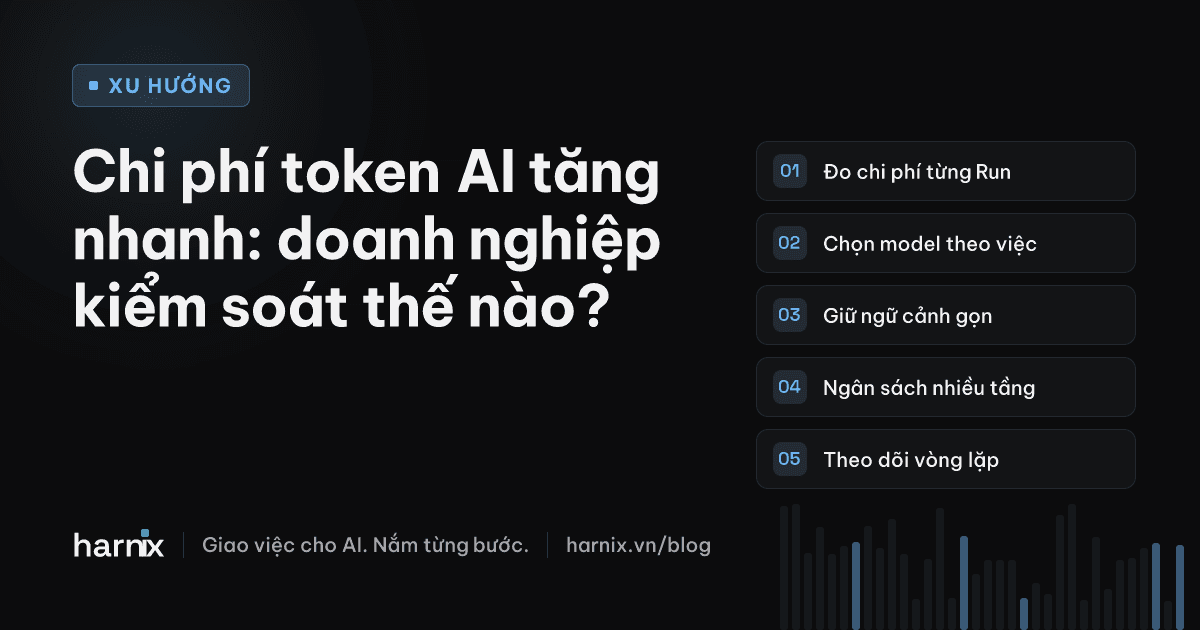
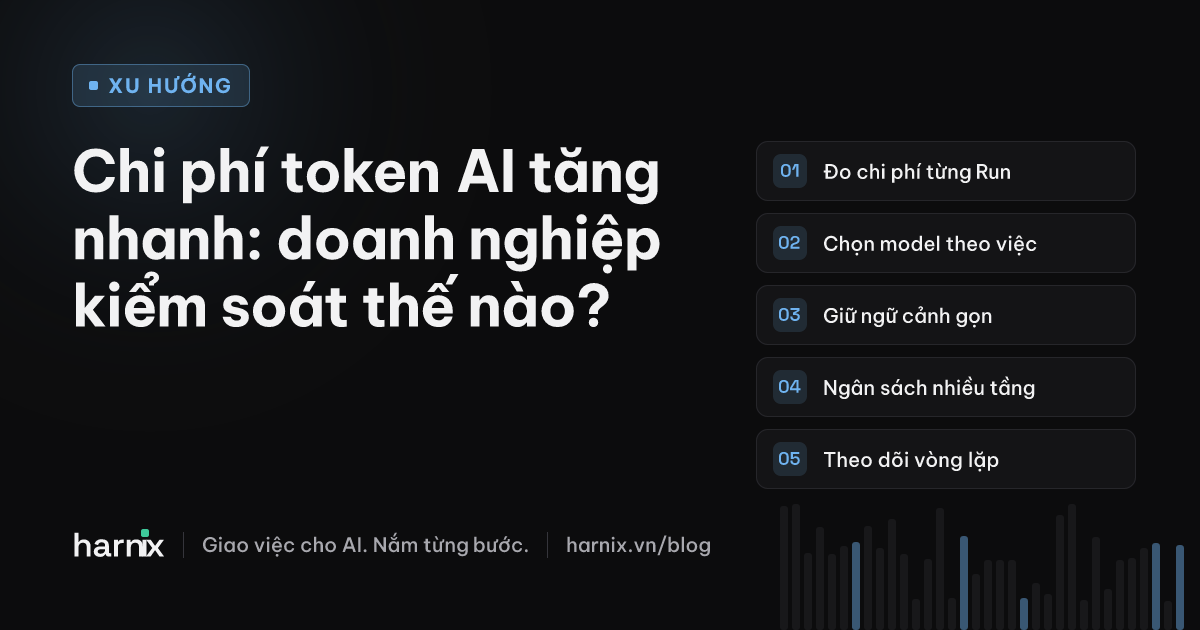
1. Measure cost per run, not just the monthly invoice
The monthly invoice from a model provider only shows the total. To see where the money goes, record tokens and cost for every run, tied to the agent, the feature and the user. Then "why did this week double?" gets a concrete answer, for example an order-lookup agent that rereads every document on every turn.
2. Match the model to the task
Group the work: FAQ answers, summaries, classification, multi-step reasoning. Try a smaller model on the simple groups first, measure quality on a sample set of questions, then decide. Keep the stronger model for the work that actually needs it.
3. Keep the context lean
Send only the document passages relevant to the question instead of whole documents. This is why RAG (retrieving documents before answering) is so widely used; see What is RAG?. Keep the system prompt short and clear, and cap the length of each message users can send.
4. Set budgets at several levels
One cap for the whole organization isn't enough. Add a cap per agent, so one misbehaving agent can't consume everyone else's budget, and a daily cap per end user, so one account can't use more than its share. When a cap is reached, users should see a clear message and another way to get help, not a cryptic error.
5. Watch for loops and outlier runs
Limit the number of steps per agent run. Each week, pull the runs that used the most tokens and open them step by step: which tools the agent called, where it repeated itself, what it read. Much of the waste tends to sit in a small number of runs like these, and fixing one prompt or one tool description is often enough to bring it down.
Quick checklist before you scale a chatbot or agent
| Question | If you can't answer it yet |
|---|---|
| How many tokens does a turn use, on average and at peak? | Turn on per-run cost recording |
| Which agent and which feature cost the most? | Tie costs to agents and features |
| What is the most one user can spend per day? | Set per-end-user budgets |
| Which tasks use a strong model they don't need? | Test a smaller model on sample questions |
| What do users see when a limit is reached? | Write the message and a fallback contact path |
How Harnix helps
In Harnix, you set usage limits and budgets per organization and per agent, plus a daily token budget for each end user, and every Run is recorded step by step so you can see what the agent read and which tools it called in unusual runs. See how to set it up in the Harnix docs, or get in touch at harnix.vn.
Frequently asked questions
What is a token in AI?
A token is the unit of text a language model uses to read, write and bill. Questions, document passages in the context and answers are all counted in tokens, usually priced separately for input and output.
Why do AI agents use more tokens than a regular chatbot?
One request can make an agent call the model several times: planning, retrieving documents, calling tools, reading results and rewriting. Each step adds tokens, so the cost per turn varies more.
Where should a small business start controlling AI costs?
Start by measuring: record tokens and cost for every run, tied to the agent and the user. Then set caps per agent and per user, and only then optimize models and prompts.
Will cutting tokens make my chatbot's answers worse?
Not necessarily. Sending only the relevant passages instead of whole documents, and using smaller models for simple tasks, often keeps quality intact. Measure on a sample set of questions before and after each change.