Agent Skills is an open standard for packaging how to do a task (instructions, examples, reference material and, optionally, scripts) into a folder that an AI agent loads only when the task comes up. On October 22, 2026, Anthropic handed the standard to the Agentic AI Foundation under the Linux Foundation, which also hosts MCP. For a business, the practical upshot is that a process you write down for an agent once can be reused across many different tools.
This post covers what Agent Skills are, why they became a talking point in October and November 2026, how they differ from system prompts, RAG and MCP, and how a business should manage skills before handing them to an agent.
What are Agent Skills?
Each skill is a folder with one required file, SKILL.md. Its header has two fields: name (a short identifier) and description (what the skill does and when to use it). The body is plain Markdown: the steps, example inputs and outputs, and edge cases. The folder can also hold reference documents, templates and scripts, according to the official specification.
What sets skills apart is how they load, an approach called progressive disclosure. Per the specification, at startup an agent reads only the name and description of every skill, about 100 tokens each. When a task matches a description, the agent reads the full instructions (recommended under 5,000 tokens and under 500 lines). Bundled files are opened only when actually needed.
A concrete example: a "handle return requests" skill holds the return policy, the questions to ask the customer, reply templates, and the cases that must go to a human. The agent does not carry that whole process into every conversation. It opens the skill only when a customer asks about a return.
Why Agent Skills are in the news
Three recent milestones pushed the topic forward:
- October 22, 2026: Anthropic transferred the Agent Skills name, logo, GitHub organization and domain to the Agentic AI Foundation (AAIF). Engineers from Anthropic, Google, OpenAI and other companies maintain the standard as individuals, according to Anthropic's announcement.
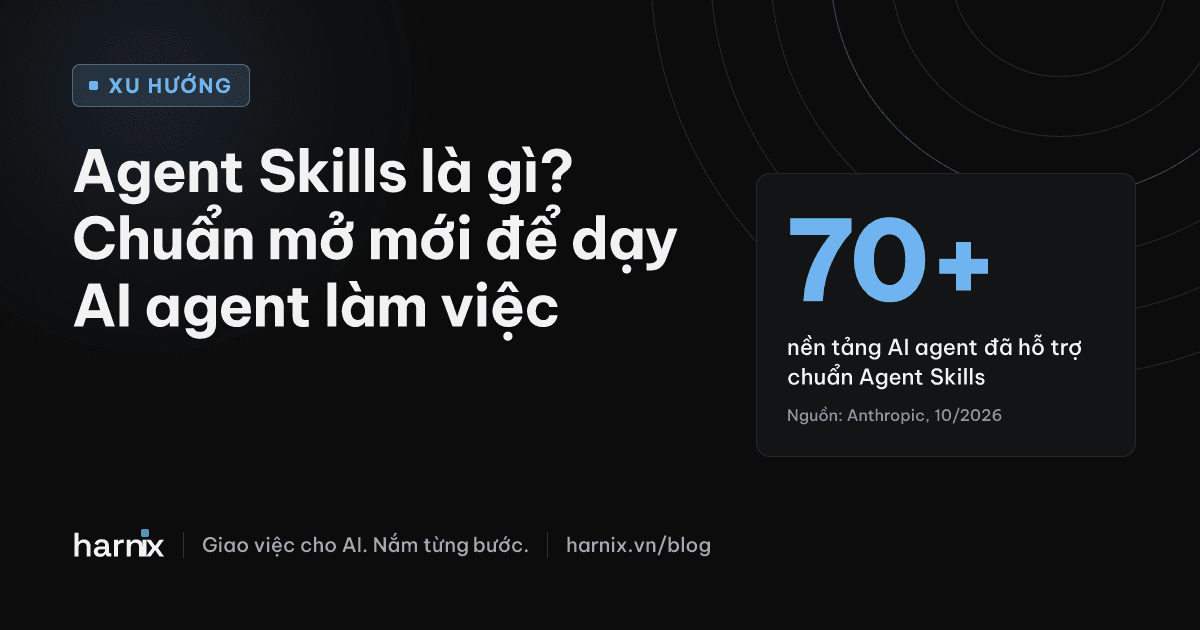
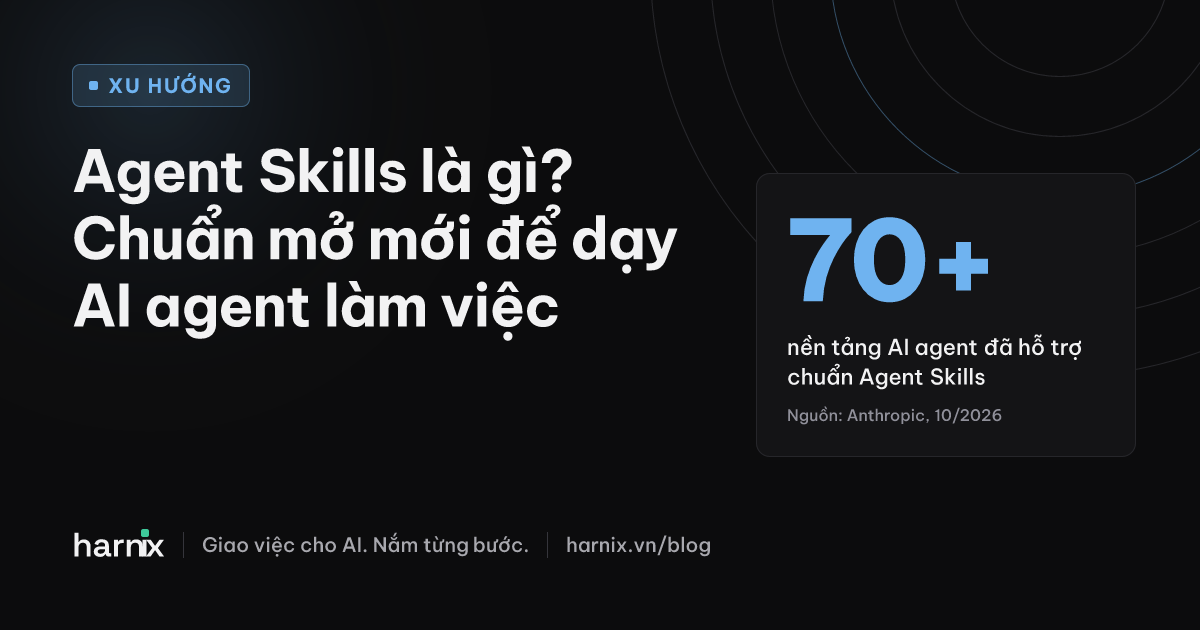
- Scale: the same announcement says more than 70 agent platforms have adopted the standard since it was published in December 2025, with about 1 million skills published and nearly 280 million installs.
- November 11, 2026: the Google Open Source Blog profiled a Google Cloud engineer who is a core maintainer of both MCP and Agent Skills; his near-term focus for the specification is packaging, discovery and versioning.
The roadmap Anthropic proposed for the standard includes versioned releases, a formal proposal process, and security guidance for people who write and install skills. Those are exactly the pieces a business needs before putting skills to work.
How Agent Skills differ from system prompts, RAG and MCP
These four ideas often get blurred together. Each answers a different question:
| Answers the question | Loaded when | Example | |
|---|---|---|---|
| System prompt | Who the agent is, its tone, its limits | Every turn | "You are a support assistant. Never promise refunds." |
| RAG (knowledge base) | What information is right for this question | When the agent searches | The warranty section of a policy PDF |
| MCP (connector) | What actions the agent can take in real systems | When the agent calls a tool | Look up an order, open a support ticket |
| Agent Skills | Which steps to follow for this task | When the task matches a skill description | A five-step process for return requests |
Google's post sums it up: skills teach an agent how to approach a problem, while MCP supplies the actions on live systems. An AAIF post adds that even with a skill, the agent still needs the right access and capabilities to do the job.
If your system prompt runs to several pages because every process is crammed into it, that is a sign some of it belongs in skills. We have separate posts on how to write a system prompt for a business chatbot and on MCP if you want to go deeper on either.
An available skill is not always a used skill
Having a skill does not mean the agent will use it. In an evaluation Vercel published in January 2026 on Next.js 16 coding tasks, the agent never invoked the skill in 56% of cases even though it was available. With the skill left on default behavior, the pass rate was 53%, the same as having no docs at all. Adding explicit instructions to use the skill raised it to 79%.
That was a coding test, so don't apply the numbers directly to a support chatbot. The lesson does carry over: the description decides whether the agent opens the skill. "Helps with returns" is too vague. A good description says what the skill does and when to use it, in the words customers actually use: "Handles size swaps, color swaps and returns within 7 days. Use when the customer mentions exchange, return, refund or wrong size."
Then test it with sample conversations and check the logs: did the agent open the right skill on the right question?
How a business should manage skills
A skill is an internal procedure written as text, so manage it the way you manage process documents:
- Give every skill an owner. When the return policy changes, who updates the skill? Record the owner and the last-updated date.
- Review before release. The AAIF post describes companies that let employees contribute skills, with a person reviewing each one before it is distributed across the organization.
- Be careful with skills from outside. A skill can contain scripts and instructions the agent will follow. Read the whole thing before attaching it to an agent, the way you would read a template contract before signing.
- Track versions. The specification lets you add fields such as
versionunder metadata. When the agent gets something wrong, you need to know which version of the skill it was using. - Check whether the agent reads the skill. A log of each run shows which skill the agent opened and on which question. Without it, you are guessing.
- Keep skills small. One skill per task. Move long material into reference files so the agent opens them only when needed, as the specification recommends, which also cuts the tokens it has to process.
Where a small business should start
You don't need dozens of skills. Pick the two or three tasks your agent handles most often and gets wrong most easily, such as returns, quotes or setup instructions. Write each one as a short skill: the steps, two or three examples, and the cases that go to a person. Run it against real customer questions, check the logs, and refine the description until the agent opens the right skill.
Because the standard is open and supported by more than 70 platforms, the effort you put into skills today is less tied to any single tool. That makes it worth starting early, even at a small scale.
In Harnix, you can write Skills or import them from GitHub or a zip file, attach them to individual agents, and each Run's trace includes a skill-reading step so you can see which skill the agent used. Scripts inside a skill are stored but not run. See the guides at harnix.vn/docs.
Frequently asked questions
Are Agent Skills only for developers?
No. Most skills are Markdown text describing a process. People who know the work (support, sales, operations) can write them; a developer is needed only when a skill includes scripts.
Do Agent Skills replace MCP?
No. A skill tells the agent which steps to follow; MCP lets the agent act on real systems. Both standards are now hosted by the Agentic AI Foundation and are often used together.
Do skills increase token costs?
Per the specification, each skill costs about 100 tokens at startup for its name and description. The full instructions load only when the task needs them, so a lean skill is usually cheaper than putting the same content in the system prompt.
Are community skills safe to use?
Treat outside skills like third-party code: read the content and any scripts before use. The standard's proposed roadmap includes security guidance for skill authors and installers, but for now each business still has to do its own review.