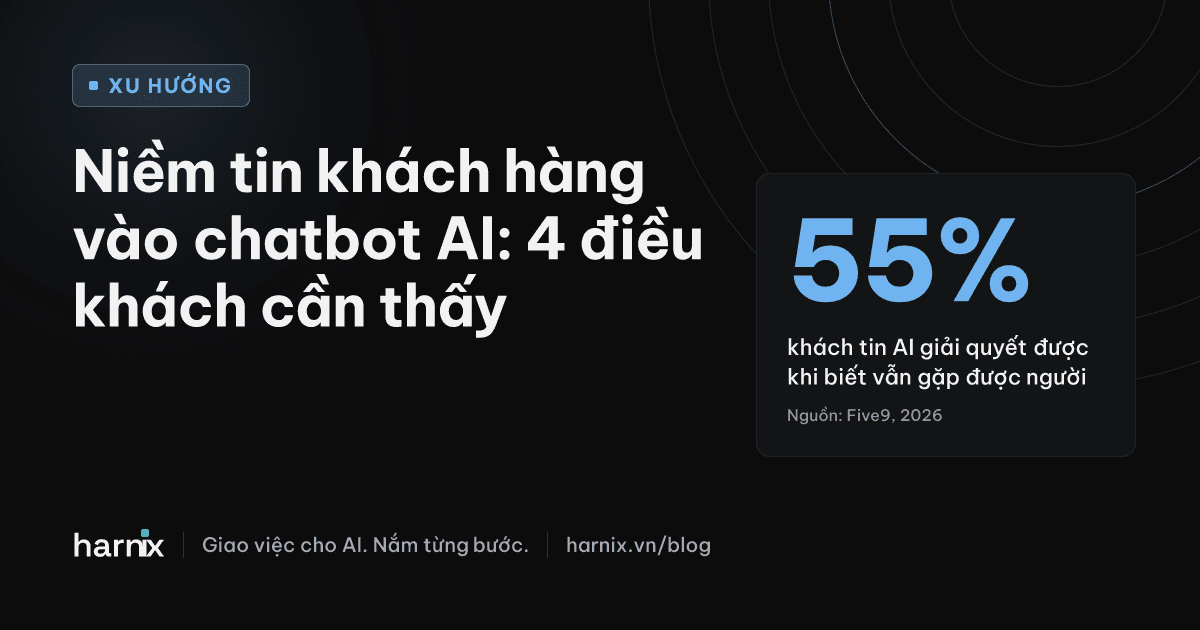
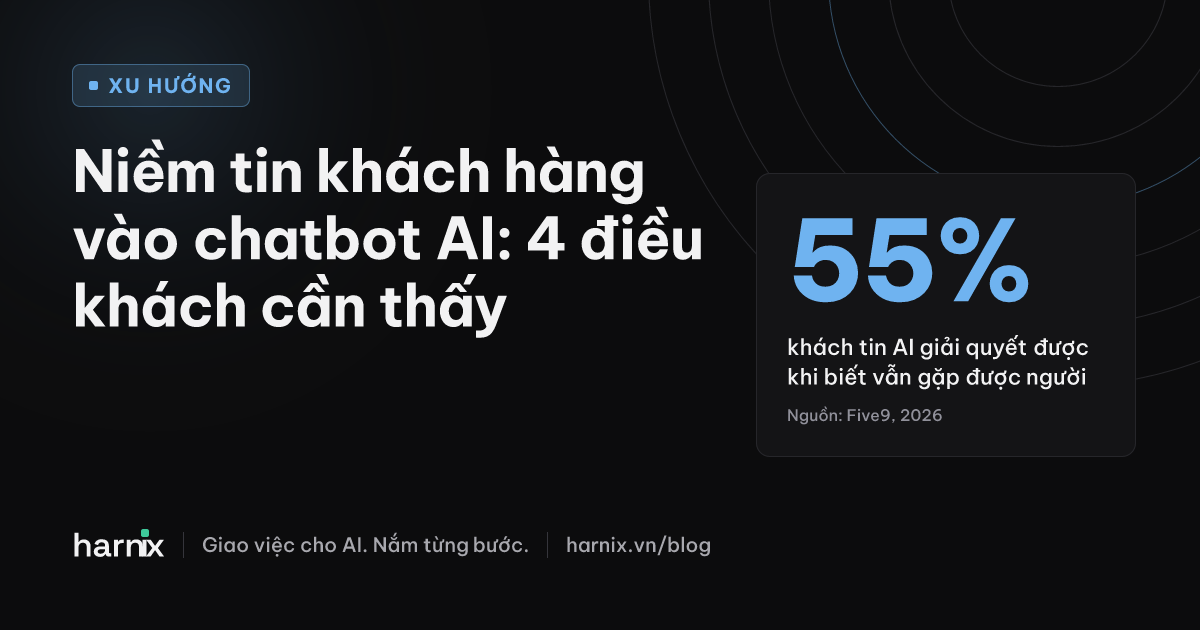
Customer trust in AI chatbots depends less on how well the bot talks and more on whether customers feel protected. In a survey of 3,000 consumers in the US, UK and Germany published by Five9 on October 14, 2026, only 26% trusted AI to resolve their issue when there was no option to reach a person, but that rose to 55% when a clear path to a human was available. In short, customers need to know they are talking to AI, know when they can reach a person, trust that the bot won't make promises the business can't keep, and not have to start over.
Why customer trust in AI chatbots matters this week
Late November is when the holiday shopping season peaks, and messages about stock, delivery and returns pile up. It is also when chatbots are under the most pressure, and small mistakes become expensive.
A survey of more than 1,000 US adults by an AI customer service vendor, released on November 4, 2026 and summarized by RetailWire on November 19, found that:
- 41% had abandoned a cart because a chatbot couldn't answer a simple question about stock or shipping.
- 72% had been frustrated by a chatbot that didn't understand their issue.
- 82% expect a credit or refund if an AI makes a promise the business doesn't keep.
- About 44% would wait less than half an hour during peak season before going elsewhere or cancelling.
Customers also show up better prepared. According to a Liveops report published on November 18, 2026 (750 US adults who had used their own AI tool to deal with a company, surveyed in October 2026), 72% had used their own AI to solve a problem without contacting the company, and 52% had repeated something their AI told them to make their case. When customers research first, a wrong or vague chatbot answer gets caught faster.
These surveys cover the US and Europe, and some were run by companies that sell customer service. They are not a forecast for any one business. The direction is consistent, though: customers aren't rejecting AI, they're asking it to earn their trust.
4 things customers need to see before they trust a chatbot
1. They know they're talking to AI
According to Five9, 71% of consumers say it is very or extremely important to know when they are talking to AI. Giving the bot a human name and letting customers guess does nothing for trust.
The fix is small: the greeting says it's an AI assistant and states what it can and can't do. For example: "I'm the store's AI assistant. I can check our return policy and delivery times. Refunds are handled by our team."
2. They can always see a way to reach a person
The 26% versus 55% gap above is the main reason. Five9 also found that 92% of consumers give AI less than 10 minutes before asking for a human, and the top reason people abandon AI (46%) is being misunderstood repeatedly.
A path to a person doesn't have to mean 24/7 staff. For a small business it can be a phone number, a messaging link, or a contact form with a stated response time. What matters is that customers see it before they need it, not after three off-topic answers.
3. The bot only promises what the business can deliver
The 82% figure matters most to store owners: customers treat what the chatbot says as what the business says. If the bot says "delivered in 2 days" or "returns accepted within 30 days" and it's wrong, customers will hold the business to it.
The survey team's own advice, quoted by RetailWire, is for AI to commit only to what the business can deliver, ground answers in approved policies, and check live order data before quoting delivery dates. In practice, that means:
- Policy documents are the latest version, with old versions removed (see how to prepare documents for an AI chatbot).
- The system prompt lists what the bot must not promise on its own: refunds, exceptions, specific delivery dates without data (see how to write a system prompt for a business chatbot).
- When information is missing, the bot asks instead of guessing (see chatbot clarifying questions).
4. They don't have to repeat themselves
Five9 found that 35% of consumers often or always have to repeat information after being handed from a bot to a person. In the Liveops sample, 84% had had to repeat to a person what they had already told a chatbot, and 69% said it is very or extremely important that the representative already has that information.
The simplest fix: when handing over to a person, pass along a summary of the issue, the order number if there is one, and what the bot has already said. The agent gets up to speed in 20 seconds, and the customer doesn't start over.
A trust checklist before peak season
| What customers need to see | How to check | Warning sign |
|---|---|---|
| They know it's AI | Reread the bot's greeting | The bot uses a human name and never says it's AI |
| A way to reach a person | Ask "let me talk to someone" | The bot repeats its last answer and offers no contact option |
| No over-promising | Ask about delivery dates, refunds, exceptions | The bot gives numbers or commitments not in your documents |
| No repeating | Check what your team receives on handover | Staff have to ask everything again |
| Correct answers to common questions | Run 20 real questions from last season | Wrong stock, shipping fee or return window |
If you only have one afternoon before the rush, do rows 2 and 3. That is where customers lose trust fastest. You can build your test set using how to test an AI chatbot before launch.
Measure trust, don't just sense it
Trust doesn't show up in total message counts. It shows up conversation by conversation: a "not helpful" click, the same question asked twice, a request for a human after two turns. Each week, pull these conversations, look at which documents the bot read and what it based its answer on, and fix the exact spot. The method is in chatbot giving wrong answers: how to find and fix weak spots, and tying it to business metrics is covered in AI customer service ROI.
In Harnix, every answer is a Run recorded step by step (documents read, tools called, token cost), along with the helpful/not helpful rating customers leave under the answer, so you can see why the bot said what it said. See how to set it up in the Harnix docs, or get in touch at harnix.vn.
Frequently asked questions
Do customers trust AI chatbots?
Yes, with conditions. In Five9's survey published in October 2026, 55% trusted AI to resolve their issue when they knew they could still reach a person, compared with 26% when that option wasn't there.
Should you tell customers they're chatting with AI?
Yes, in the first message. 71% of consumers in the Five9 survey said knowing they're talking to AI is very or extremely important.
Is a business responsible when its chatbot gets something wrong?
Legally, it depends on the country and the case. In terms of customer expectations, 82% of US adults in a November 2026 survey said businesses should offer a credit or refund if their AI makes a promise they don't keep. The safest approach is not to let the bot commit to refunds or delivery dates without data.
Where should a small business start?
Add a greeting that says the bot is AI, make the path to a person easy to see, and stop the bot from promising refunds, exceptions or delivery dates on its own. All three can be done in an afternoon.