A multi-agent system splits one large job across several AI agents: a lead agent plans the work, other agents each handle a piece, and the results are combined. It shines on work that can be broken up and run in parallel, but it uses far more tokens and is harder to debug. For most business chatbots and assistants, one well-built agent is still the right place to start.
What is a multi-agent system?
A multi-agent system is a set of agents, each with its own instructions, tools and data sources, working together toward one goal. The most common pattern is orchestrator-worker: a lead agent breaks the task down, hands pieces to subagents running in parallel, waits for their results and writes the final answer.
Anthropic describes its multi-agent research system in exactly these terms: a lead agent plans the research, and subagents search different parts of the question at the same time before reporting back.
Compared with a single agent, there is an extra layer of work: delegating, passing data between agents and merging results. That layer is where both the power and the risk come from.
Why multi-agent is in the news in November 2026
Several announcements this week point the same way: instead of one assistant answering one question at a time, vendors are shipping "teams" of agents that work toward a goal.
- On November 17, 2026, Replit introduced Missions: you set an outcome, and a swarm of agents plans, builds, tests and iterates toward it. Users set a spending limit, must approve steps such as contacting prospects or sharing a proposal, and an independent AI judge checks results against agreed success criteria. The company says it used Missions to build an application monitoring platform in 2 days on a $3,000 budget (company-reported).
- At Microsoft Ignite, November 17–19, 2026, Agent 365 is being repositioned as the observability layer for agents, models and assistants, with sessions on AI budget guardrails and cross-vendor usage monitoring.
- Earlier this year, Databricks' State of AI Agents report (telemetry from more than 20,000 organizations) found multi-agent workflows grew 327% in four months, and that more than a third of agent usage follows a "supervisor agent delegates to specialist agents" pattern.
The common thread: the more agents you run, the more governance (budgets, approvals, observability) moves to the front.
When should you use more than one agent?
Short answer: when the work splits into independent parts, is valuable enough to justify the extra cost, and each part needs different tools or access.
| Situation | One agent | Multiple agents |
|---|---|---|
| Chatbot answering from documents and policies | Good fit | Usually unnecessary |
| Work that shares a lot of context, with tightly dependent steps | Better fit | Agents easily drift out of sync |
| Broad research with many parallel lines of search | Slow, context fills up | Good fit |
| Parts that need separate tools, data or access | Hard to keep boundaries | Good fit, one scope per agent |
| Low-value tasks run at high volume | Good fit | Cost is hard to recover |
Microsoft gives similar advice in its Copilot Studio multi-agent patterns guidance: start with one agent, split only when you need a boundary that agent should not cross, and don't create a separate agent for every subtask.
The cost of multi-agent: tokens, latency and compounding errors
Token use multiplies
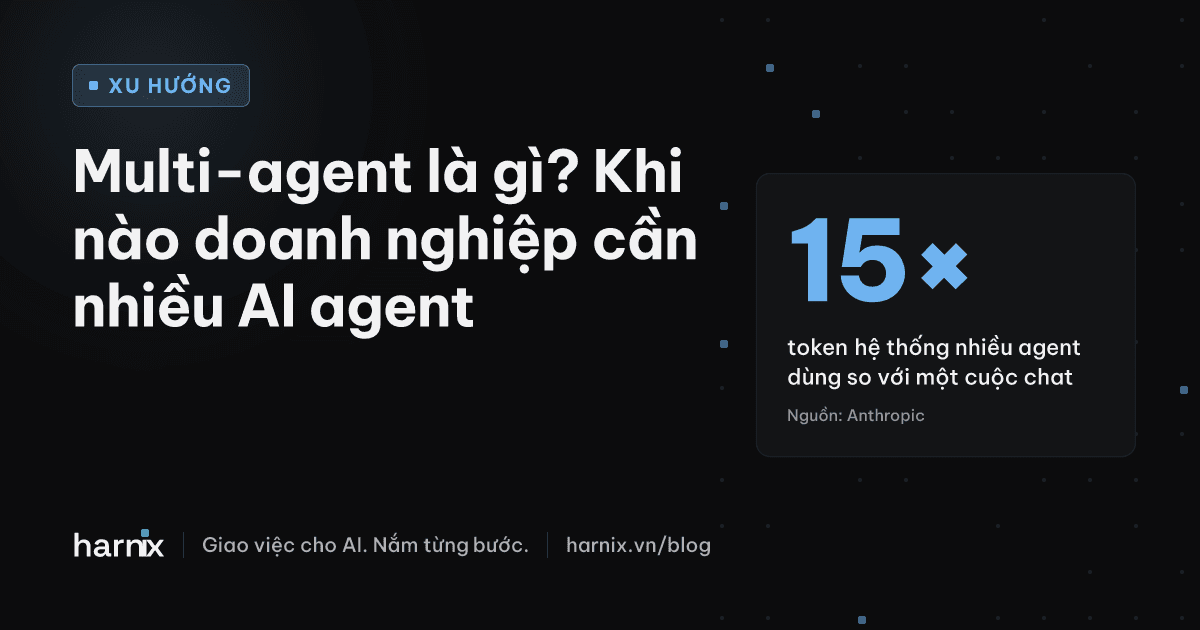
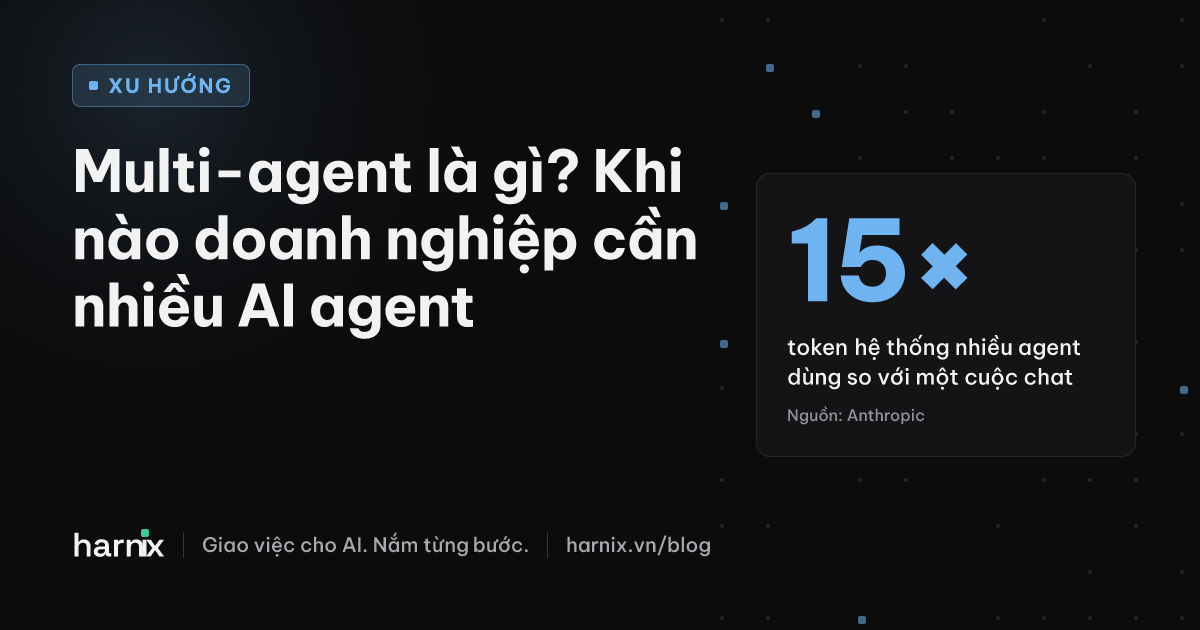
According to Anthropic, agents typically use about 4× more tokens than chat interactions, and multi-agent systems about 15×. In return, on its internal research eval, the multi-agent setup outperformed a single agent by 90.2%. Their own conclusion: it only pays off for tasks valuable enough to cover the cost. See also our post on AI token costs.
Errors spread across layers
The study "Why Do Multi-Agent LLM Systems Fail?" analyzed more than 1,600 traces from 7 popular multi-agent frameworks and identified 14 failure modes in three groups: system design, misalignment between agents, and task verification. In other words, many failures come not from the model but from how agents hand off work and check each other.
It gets hard to tell who did what
A wrong answer might start with a subagent reading the wrong document, the lead agent merging badly, or two agents searching the same source. Without a step-by-step log for each agent, your team can only guess. That is why AI agent observability matters more as the number of agents grows.
5 rules if you do run multiple agents
- Only one agent talks to the user. Subagents report back to the lead agent instead of answering customers directly, so you avoid duplicate or conflicting replies.
- Delegate precisely. Every handoff needs an objective, an output format, the tools to use and clear boundaries. Anthropic found that vague instructions led subagents to duplicate work or leave gaps.
- Give each agent its own scope. Non-overlapping data sources, minimal tools. A subagent should never have broader access than the lead agent, and write actions still need human confirmation, as covered in AI agent permissions.
- Set a budget before you start. A token or spending cap for the whole task, and a hard stop when it is reached rather than carrying on.
- Trace every agent and link the traces. For each step you need to know which agent read what, called which tool and spent how much, so you can locate the failure.
Many of these rules are context engineering rules too: each agent should see only the context it needs.
How should a small or mid-sized business start?
- Get one agent working well first: clean documents, clear tools and a test set, as in how to test an AI chatbot before launch.
- Note where that agent hits its limits: context too long, access that needs separating, or a job that is too broad.
- Add an agent only at that point, measure quality and cost again, then expand.
FAQ
Is a multi-agent system better than one agent?
Not always. It does better on work that can be split and run in parallel, but it uses far more tokens and is harder to debug. For answering questions from documents, one agent is usually enough.
How much does multi-agent cost?
According to Anthropic, multi-agent systems use about 15× more tokens than a regular chat. Set a budget for the whole task and track cost at every step.
Is a scheduled agent the same as multi-agent?
No. A scheduled agent is one agent triggered on a timetable. Multi-agent means several agents coordinating on the same task. See scheduled AI agents.
What do you need to run multiple agents safely?
A clear access scope for each agent, human confirmation for write actions, a token budget, and a step-by-step log showing which agent did what.
Whether you run one agent or several, Harnix records every Run (documents read, tools called, token cost) and lets you set token budgets, so you know what an agent did before you hand it more work. Learn more in the Harnix docs or get in touch at harnix.vn.