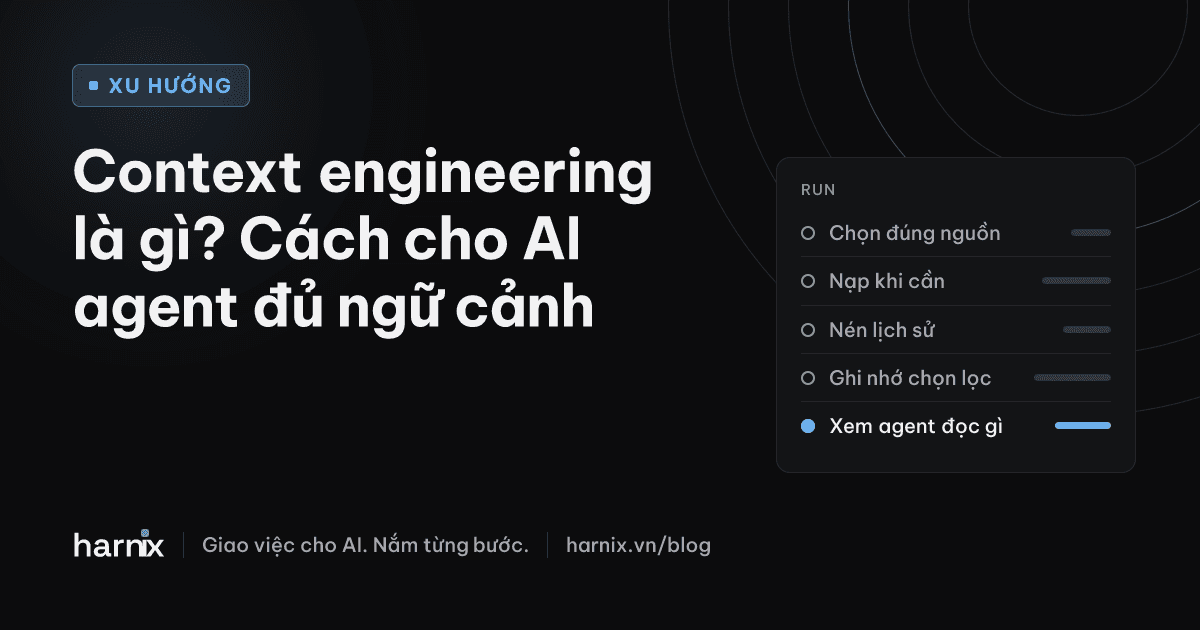
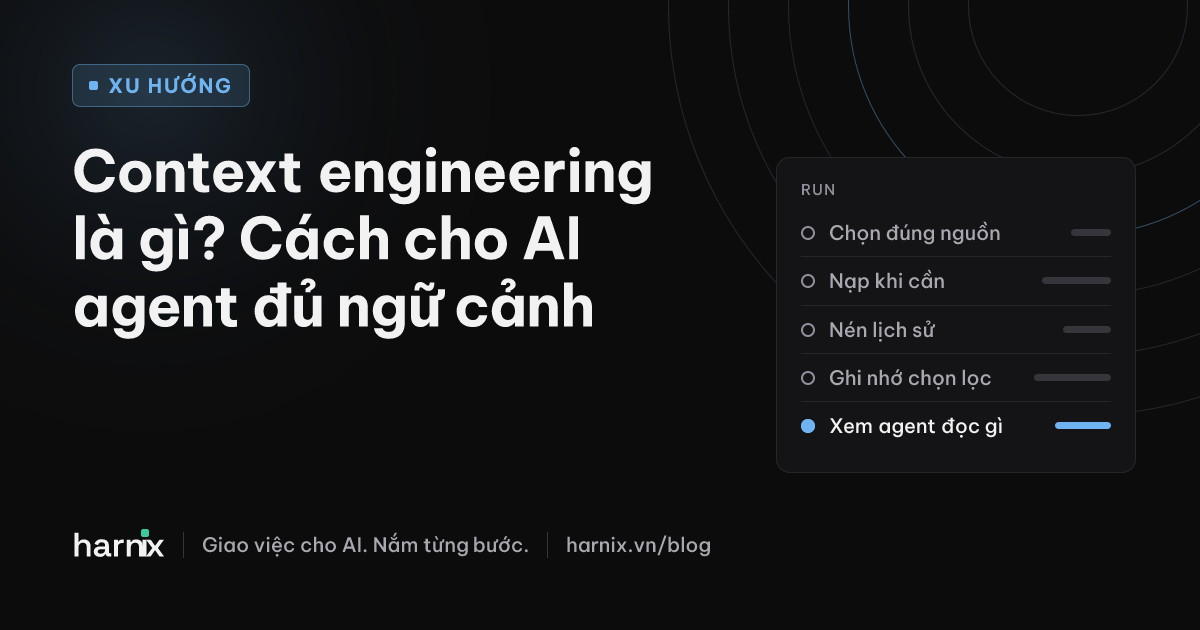
Context engineering is the practice of choosing and arranging what an AI agent sees at each step: instructions, documents, tool results, conversation history. When an agent gives a confidently wrong answer, the cause is often not the model but missing, excessive, or misleading context. In 2026 it has become one of the most discussed topics among teams building AI agents.
What is context engineering?
Anthropic's engineering guide defines context engineering as the set of strategies for curating and maintaining the optimal set of information a model sees while it runs. Prompt engineering is about writing good instructions; context engineering is broader: what the agent gets to see, when, and what gets left out.
An agent's context usually has five parts:
- System instructions (the system prompt): role, scope, tone.
- Reference documents: policies, price lists, product guides (often via RAG).
- Tools: each tool's description, plus the results it returns.
- History: past turns and the steps the agent has taken.
- Memory: notes stored outside the conversation for later use.
The key point: more is not better. Anthropic notes that as context grows, the model's ability to recall information from it accurately declines, and describes this as the model's limited "attention budget."
Why context engineering is a hot topic in 2026
As agents move from pilots into real work, context failures become more visible than model failures.
- In a June 2026 VB Pulse survey by VentureBeat of 101 enterprises with more than 100 employees, 57% had traced a confident but wrong agent answer to missing or inconsistent business context in the previous six months; 31% said it happened more than once.
- In the same survey, 38% use retrieval over documents as their default way to give agents business context.
- A BARC study (published September 3, 2026, sponsored by DataHub) of 285 data, AI, IT, and business stakeholders found data quality and preparation to be the top challenge (49%), ahead of AI model limitations (29%).
- On November 2, 2026, LangChain CEO Harrison Chase wrote that as agents run longer in the background and work toward goals rather than single tasks, new context problems appear: memory (what to keep, what to drop), asynchronous work, and tracking long-term goals.
A caveat: both surveys have moderate sample sizes and one is vendor-sponsored, so read them as trend signals, not numbers that apply to every business.
Prompt engineering vs. RAG vs. context engineering
| Prompt engineering | RAG | Context engineering | |
|---|---|---|---|
| Question it answers | How should the instructions read? | Which documents to retrieve? | What does the agent see, when, and what is left out? |
| Scope | One block of text | The reference documents | All information across every step |
| Common failure | Vague or overly rigid instructions | Wrong passage, outdated document | Bloated, conflicting, or stale context |
In short, the system prompt and RAG are two pieces of the context engineering picture.
5 things businesses can do to give agents the right context
1. Pick the right sources; remove duplicates and outdated files
An agent that reads two different price lists will answer from either one. Before adding documents, remove old versions, merge duplicates, and mark effective dates. It is the cheapest fix and often the most effective.
2. Load information when it is needed, not all up front
Anthropic calls this "just-in-time" retrieval: the agent keeps lightweight references (links, queries) and fetches data with tools only when needed. For data that changes constantly, such as stock levels or order status, calling a tool for live data usually beats copying it into documents. MCP is a standard way to connect agents to these sources.
3. Keep tools and instructions clear and minimal
Too many overlapping tools make agents pick the wrong one. Each tool should have a clear purpose and a short description. Instructions should sit at the "right altitude": not hardcoded if-else branches, not vague advice like "answer well." A few representative examples beat a long list of every edge case.
4. Compress history and remember selectively
Long conversations bloat the context. Two common techniques: summarize the history as it nears the limit (compaction), and let the agent write important notes outside the conversation to read back later. For long tasks, sub-agents can work with clean context and return only a summary. Packaging procedures as Agent Skills also lets the agent load detailed instructions only when needed.
5. See what the agent read before it answered
When an answer is wrong, the first question is: which documents did the agent see, which tools did it call, what came back? Without a step-by-step record, the team can only guess. With one, you can tell whether the problem is the source (a wrong document), the retrieval (the wrong passage), or the writing of the answer. See also our post on AI agent observability.
Where should a small business start?
You don't need a complex "context layer" on day one. A practical path:
- Collect 20–30 real customer questions, run them, and mark the wrong answers.
- For each wrong answer, check what the agent read. Classify it: missing document, outdated document, wrong retrieval, or vague instructions.
- Fix the sources first (documents, tool descriptions), then the prompt.
- Re-run the question set after every fix.
This is also the foundation for testing a chatbot before launch.
FAQ
Does context engineering replace prompt engineering?
No. The prompt (system instructions) is one part of the context. Context engineering also covers documents, tools, history, and memory.
Will a model with a bigger context window solve the problem?
Only partly. A longer context holds more, but recall accuracy drops as context grows, and token costs go up.
How do I tell whether an agent failed because of context or the model?
Review each step the agent read. If the correct information was in the context and the agent still got it wrong, look at the instructions or the model. If it wasn't there, it's a context problem.
Do small businesses need context engineering?
Yes, in a simple form: lean, current documents, clear tools, and a way to see what the agent read.
In Harnix, every Run records the documents the agent read, the tools it called, and the token cost, and Skills are attached per agent, so you can check what context the agent had before it answered. Learn more in the Harnix docs or get in touch at harnix.vn.