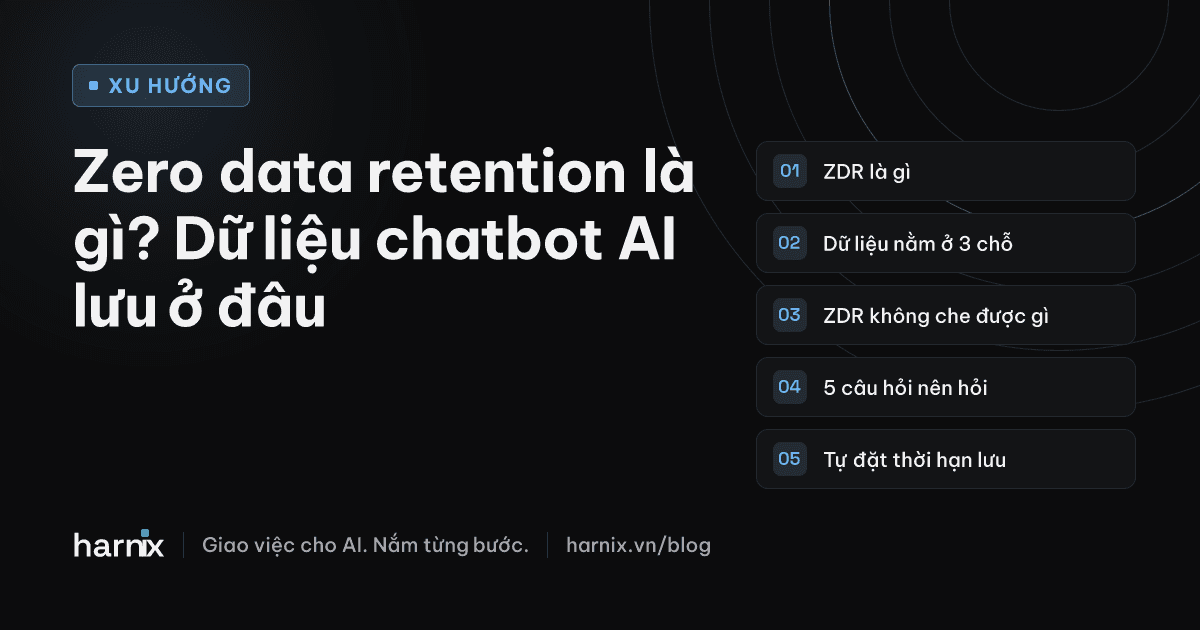
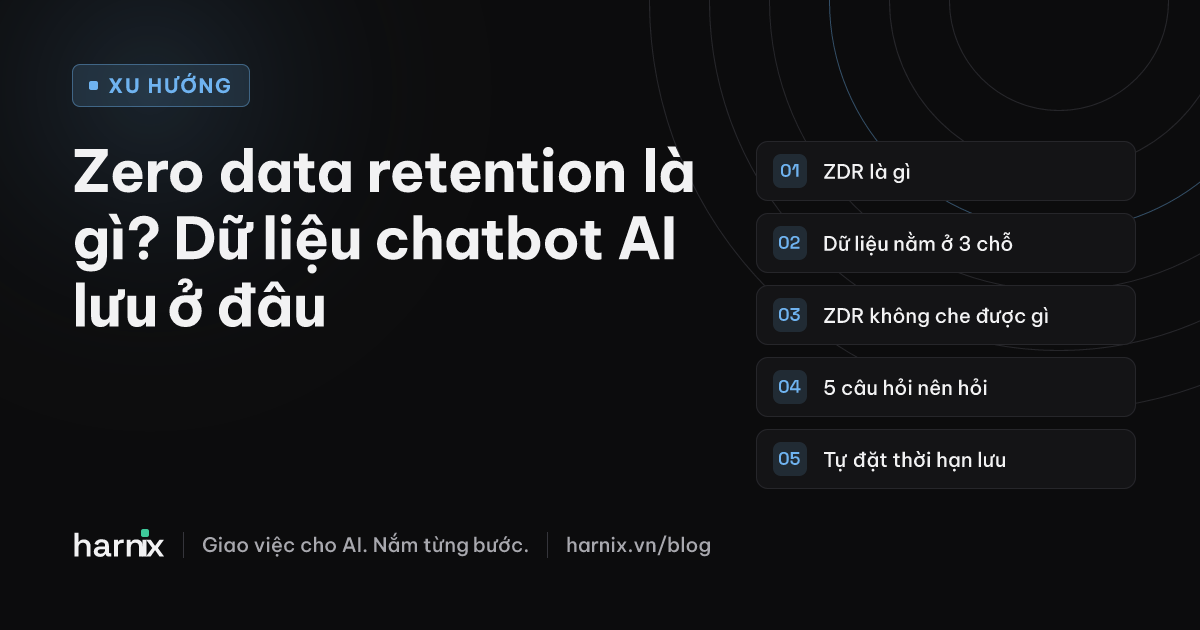
Zero data retention (ZDR) is a commitment from an AI model provider that your prompts and responses are not stored once the result has been returned. It is a meaningful safeguard, but it only covers the model provider's side. Your chatbot data also lives in conversation history, agent traces, knowledge documents and the images customers send, and how long those are kept is your decision.
Why zero data retention is in the news in late 2026
On November 23, 2026, Anthropic opened a public beta of Enterprise Frontier Safeguards (EFS), a misuse-detection setup in which the data sits in the customer's own cloud infrastructure, according to The Next Web. The article frames it as a response to enterprise pushback over the 30-day data retention the company introduced with its Fable 5 models.
In its original announcement, Anthropic describes EFS as combining the privacy of zero data retention with misuse detection. More than 100 customers helped develop it, data is stored in cloud storage the customer controls, and Anthropic doesn't charge for it. The Next Web also notes that OpenAI previewed a similar system in August.
The interesting part isn't any one company. It's a question every business using AI eventually runs into: providers need some data to catch misuse, while businesses want as little of their data kept as possible. How the two sides settle that is changing quickly.
What is zero data retention?
According to Anthropic's documentation, under a ZDR arrangement the provider does not store customer prompts or responses at rest after the API response is returned. ZDR is enabled per organization through the account team. It isn't a switch everyone can flip.
Defaults also differ between providers, so read them carefully:
- Anthropic: API conversation content is not retained by default, except for certain models that require 30-day retention. Retained data is not used for model training without the customer's permission (source).
- OpenAI: data sent through the API is not used to train models unless the customer opts in. Abuse monitoring logs are kept for up to 30 days by default. ZDR requires prior approval from OpenAI (source).
In short: "not used for training" and "not stored" are two different promises. Many teams treat them as one.
Your chatbot data lives in 3 places
When a customer sends your chatbot a message, the content can pass through three layers of storage. Each layer has a different owner for the retention decision.
| Where it's stored | Examples | Who decides how long |
|---|---|---|
| Model provider logs | Abuse monitoring logs, flagged content | The provider, under your contract or ZDR agreement |
| Provider features that keep state | Uploaded files, vector stores, API-side conversations, batch jobs | The provider and you (often kept until you delete it) |
| The app or platform you use | Conversation history, step-by-step agent traces, knowledge documents, customer images | You |
The third layer is the one that gets forgotten. An agent trace can hold the full prompt, retrieved document passages and data returned from other software. If the agent is connected to your CRM or order system, the trace may contain customer details too.
What ZDR won't cover
ZDR on the model side doesn't delete data anywhere else. The official documentation from both major providers is clear about the limits:
- OpenAI lists endpoints that keep "application state", such as files, vector stores and conversations. These are not ZDR-eligible, the data is kept until deleted, and they may still store application state even when ZDR is enabled (source).
- Anthropic states that the Files API keeps files until they are deleted or expire, batch processing has 29-day retention, and the MCP connector, Agent Skills and the Console playground are not covered by ZDR (source).
- OpenAI also notes logs may be kept longer when required by law.
So "our provider offers ZDR" doesn't answer "where is our customers' data right now?" It only answers it for one of the three layers.
5 questions to ask before choosing an AI platform
Whether you call an API directly or use a chatbot platform, these five questions help you map your data:
- Is the data used to train models? Ask each model provider and any platform in between.
- How long are logs kept, where, and who can see them? Include the provider's support staff.
- Which features fall outside ZDR? Files, document stores, connectors and batch jobs often have their own rules.
- How long are conversations and traces kept in your own app, and are they deleted automatically? This is where you have the most control.
- How do you delete one customer's data? When a customer asks, you need to know which layers to clear.
If employees are using personal AI tools to handle company data, the map gets many more blind spots. Our piece on shadow AI covers that in more depth.
Set your own retention period
Keeping less is safer, but keeping nothing leaves you with nothing to review when the bot gets an answer wrong. As we wrote in our article on AI agent observability, step-by-step traces are how you find out why an agent did what it did.
A reasonable balance:
- Separate content from metrics. Keep detailed content (prompts, tool results) for a short period for debugging. Keep metrics (duration, tokens, status) longer to track cost and quality.
- Put a number on it. Write down how many days traces are kept rather than defaulting to forever.
- Collect less at the source. Remind customers not to send information you don't need. For customer photos, see our guide on chatbot image input.
- Write the decision down. A short page on where data lives, how long it's kept and who can see it is enough to answer customers or partners when they ask.
In Harnix, the step content of each Run (prompts sent to the model, tool calls and their results) is deleted automatically once it is older than the retention period that applies to the organization, while status, duration, tokens and the final answer are kept. Data is separated between organizations. Details are in the Harnix docs.
Frequently asked questions
Does zero data retention mean data is never stored? Not quite. ZDR covers prompts and responses on the model provider's side, for eligible features. Files, document stores and the data in your own app follow their own rules.
Is my API data used to train models? For the Anthropic and OpenAI APIs, the official documentation says no by default unless the customer agrees. But not training is different from not storing.
Does a small business need ZDR? ZDR usually has to be requested and approved per organization. For most small and mid-sized businesses, the first step is controlling the data layer inside your own app, because that's where customer data stays the longest.
If we have ZDR, do we still need an internal data policy? Yes. ZDR answers for one layer only. You still need to decide how long conversations, traces and documents in your own systems are kept and who can see them.
To see how Harnix records and limits the data of each Run, read the docs at harnix.vn/docs or get in touch through harnix.vn.